Building evaluation readiness through research-practitioner partnerships: Lessons from a community-based reentry program (Forthcoming)
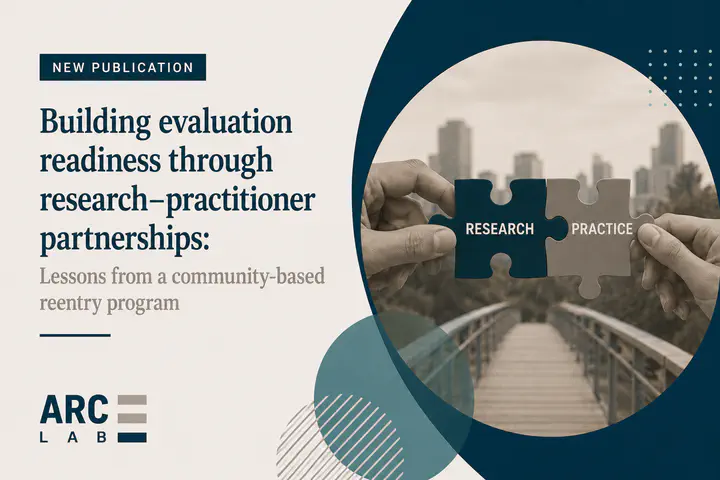
Abstract
Community-based prisoner transitional living programs play a critical role in supporting individuals returning to the community from prison, but many require substantial developmental work before they are ready for rigorous evaluation. This pre-evaluation work remains largely undocumented in published research. Using a practice-oriented case study of a research-practitioner partnership within the Never Give Up Transitional Living program, this study examines how evaluation readiness developed over approximately 2.5 years before formal evaluation began. Drawing on evaluation capacity building, implementation science, and translational criminology, we identify five interrelated processes through which researchers and practitioners built the organizational capacity needed to support future evaluation. These include: (1) building trust and shared ownership, (2) collaboratively formalizing program operations, (3) developing shared evaluative language, (4) adapting to organizational change, and (5) aligning evaluation strategies with program values. Over the course of the partnership, this work produced standardized organizational materials, documentation systems, and a staged evaluation pathway that now supports ongoing process and pilot outcome evaluations. By documenting the work that precedes formal evaluation, this study makes a typically overlooked phase of the evaluation process visible and offers practical guidance for researchers and practitioners working to build evaluation capacity within community-based organizations.


Taylor Gonzales
Ph.D. Candidate
My research centers around corrections, recidivism, and program evaluations.

Jennifer Tostlebe
Assistant Professor
My research focuses on criminological theory and empirical tests of it within institutional corrections and prisoner reentry, system responses to incarcerated and previously incarcerated individuals, and the intersection between individual differences and social influences.