Risk vs Needs Assessments
Prediction is not the same as intervention.
Risk assessment and needs assessment are related, but they are not the same thing. One asks how likely an outcome is. The other asks what factors should be targeted for intervention.
Good prediction does not automatically tell us what to treat.
What Risk Assessment Asks
A risk assessment asks:
Examples include:
- recidivism
- violence
- failure to appear
These tools are often used to inform:
- supervision intensity
- classification
- release decisions
Risk and needs assessments ask different questions
Risk assessment focuses on how likely an outcome is. Needs assessment focuses on what factors should be targeted for intervention.
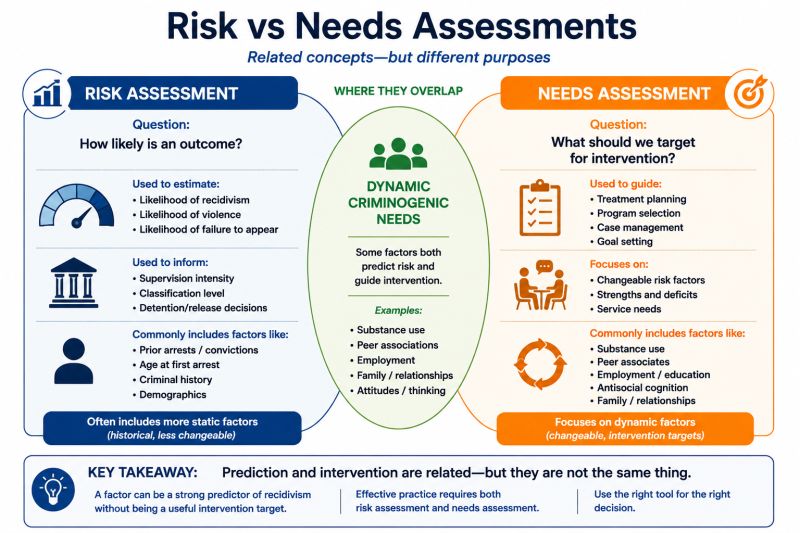
Some dynamic criminogenic needs can do both, but prediction and intervention are still different tasks.
What Needs Assessment Asks
A needs assessment asks a different question:
Examples include:
- substance use
- peer associations
- employment
- antisocial cognition
These tools are used to guide:
- treatment planning
- programming
- case management
Some Factors Do Both
Some factors do both. Dynamic criminogenic needs can:
- predict recidivism
- serve as intervention targets
That overlap matters, but it does not make prediction and intervention the same thing.
Why This Matters
- Prediction is not the same as intervention
- Some strong predictors are not easily changeable
- Effective correctional practice requires both risk and needs assessment
Bottom Line
Good prediction does not automatically tell us what to treat. Risk assessment helps estimate likelihood; needs assessment helps identify intervention targets.

Zachary Hamilton
Professor
My research centers on innovation in risk and needs assessment development.