Criminal History Predicts Risk—But Is It a Need?
Strong predictor does not mean good intervention target.
One of the strongest predictors of future offending is criminal history. That finding has been replicated for decades. But there is an important distinction: strong predictor does not mean good intervention target.
Criminal history helps estimate risk, but not what to change.
Why Criminal History Predicts Risk
Criminal history is useful because it captures accumulated risk exposure over time. People with more extensive criminal histories reoffend at higher rates.
That makes criminal history very useful for prediction.
Predictors are not always needs
Criminal history is a strong predictor of future offending, but it is not something practitioners can directly change through intervention.
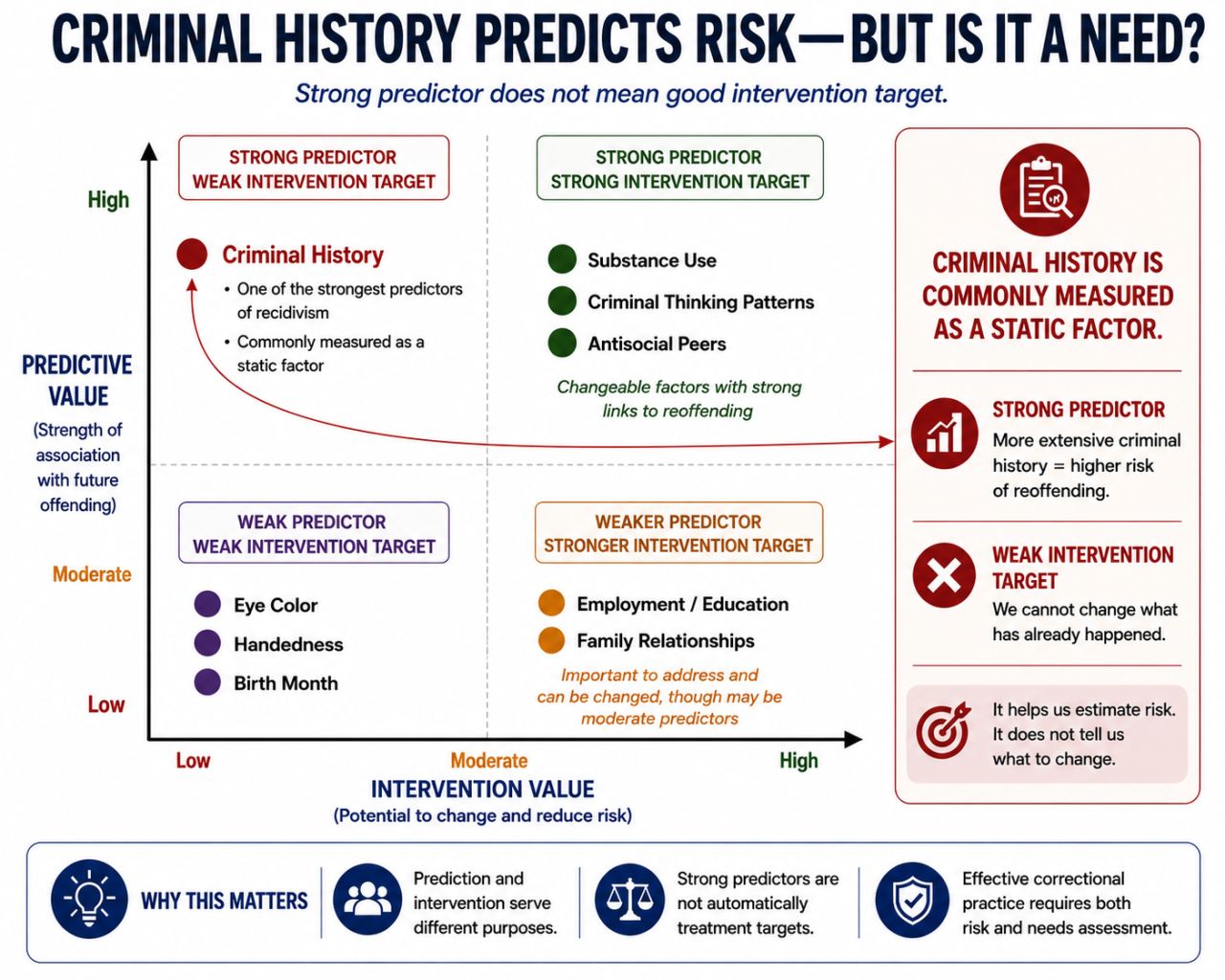
Some factors help predict recidivism. Fewer factors also guide intervention.
Why It Is Not a Direct Intervention Target
Criminal history is commonly measured as a static factor. We cannot:
- change prior arrests
- change prior convictions
- change age at first arrest
That makes criminal history much less useful for intervention.
What Can Be Targeted
By contrast, factors such as substance use, peer associations, and criminal thinking patterns may be somewhat less predictive than criminal history alone, but they can change and become targets for intervention.
What Belongs in an Assessment?
Notice the lower-left corner of the figure. Many characteristics can be measured. Very few help predict recidivism or guide intervention.
This is an important lesson in assessment development: just because something can be measured does not mean it belongs in an assessment.
Why This Matters
- Prediction and intervention serve different purposes
- Strong predictors are not automatically treatment targets
- Effective correctional practice requires both risk and needs assessment
Bottom Line
Criminal history helps estimate risk, but not what to change. Strong predictors are not automatically good treatment targets.

Zachary Hamilton
Professor
My research centers on innovation in risk and needs assessment development.