How Scores Are Built
Where risk scores come from.
In the last module, we saw that a risk score reflects what tends to happen among people with similar scores. So where do those scores come from? They are built from a set of factors, or “items,” that are combined into a single score.
Risk scores are built from multiple items, and how those items are combined matters.
What Goes Into a Risk Score
Each item captures something about a person. Common examples include:
- prior history
- age
- substance use
- employment
- peer associations
These items are then combined into a single score.
From Items to a Score
The figure below shows a simplified example of how items are combined into a score.
How risk scores are built
Risk scores are constructed by combining information from multiple items into a single value. The same inputs can be combined in different ways.
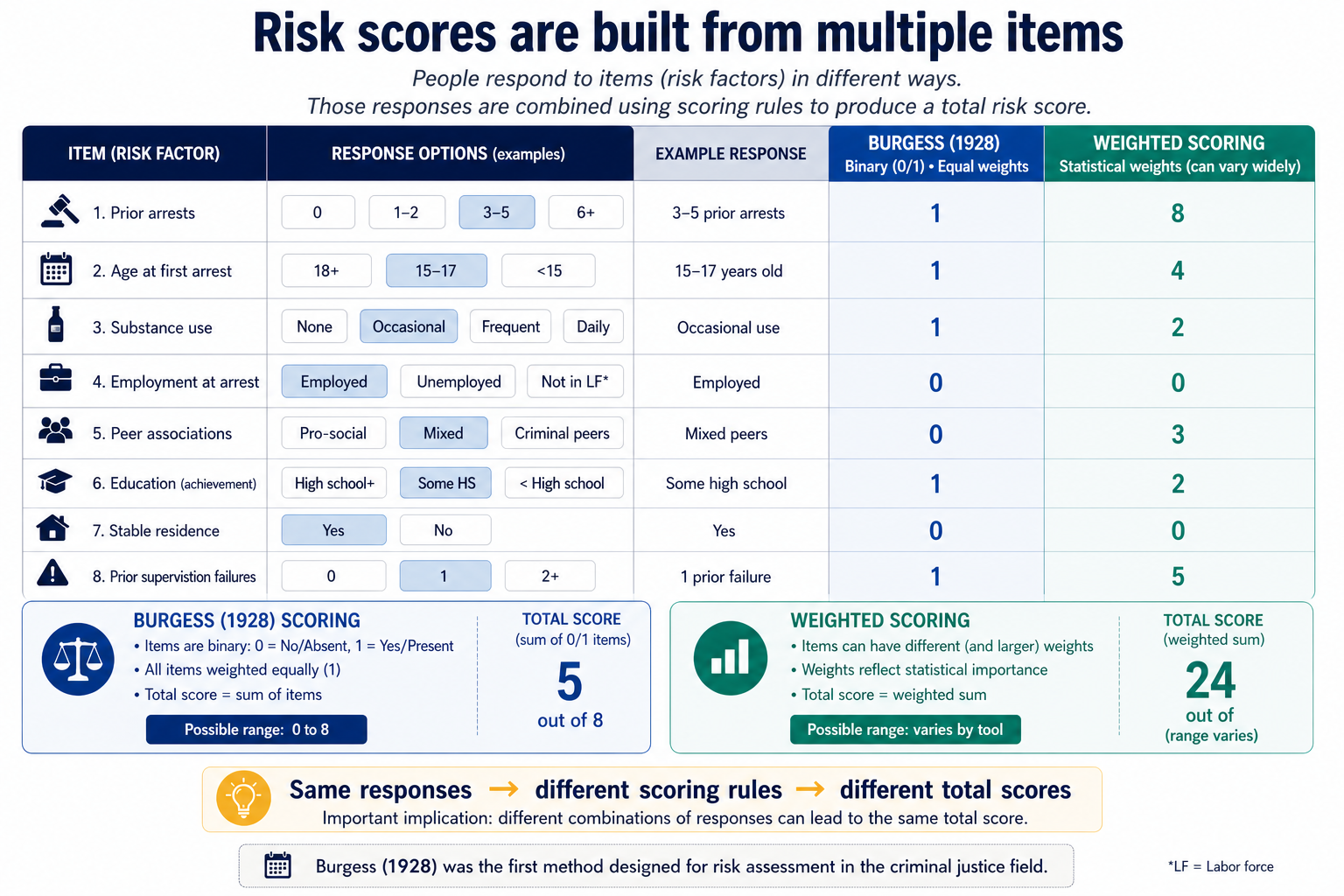
Different tools use different scoring rules—some treat all items equally, while others weight items based on their relationship to outcomes.
Two Common Approaches
There are two common ways to combine items into a score:
1. Burgess-style scoring (e.g., LS/CMI; ORAS)
- Items are typically binary (0/1)
- Each item contributes equally
- Simple and easy to hand score
2. Statistically weighted scoring (e.g., COMPAS; STRONG-R)
- Items can have different weights
- Weights reflect relationships with outcomes, such as recidivism
Why This Matters
The same inputs can produce different scores depending on how they are combined.
Burgess-style tools emphasize simplicity and transparency. Weighted approaches often achieve higher predictive accuracy, though the magnitude of that improvement varies.
Bottom Line
Risk scores are built from a set of items. The way those items are combined shapes what the score means and how well it performs.

Zachary Hamilton
Professor
My research centers on innovation in risk and needs assessment development.