Separation (Accuracy)
Accuracy is meaningful separation.
When people talk about a “more accurate” risk assessment tool, what do they mean? It is not just about getting individual cases right. A stronger tool separates lower- and higher-risk individuals more clearly.
Accuracy is about how well a tool separates outcomes—not just how often it is “right.”
Two Tools Can Behave Differently
Both tools in the figure below assign risk scores. But they behave very differently.
- One creates greater separation between lower- and higher-risk individuals
- The other compresses people into a narrower range of probabilities
Accuracy means separation
Two tools can assign risk scores, but differ in how much they separate lower- and higher-risk individuals.
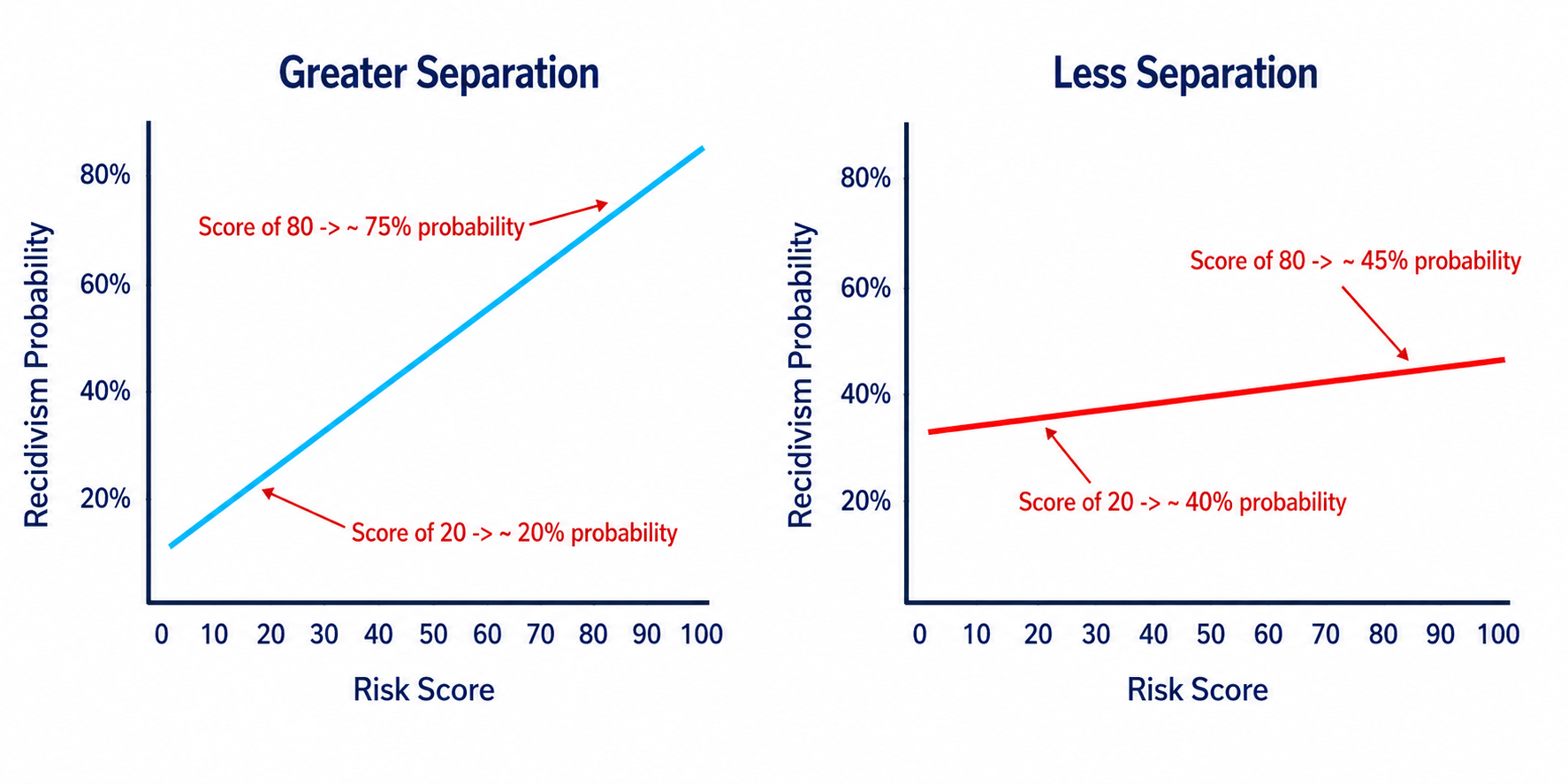
A stronger tool creates clearer separation across risk levels. A weaker tool compresses people into a narrower range of predicted probabilities.
How to Read the Figure
The same score can correspond to very different predicted probabilities depending on the tool.
- At a score of 20, one tool corresponds to about 20% risk, while the other corresponds to about 40%
- At a score of 80, one tool corresponds to about 75% risk, while the other corresponds to about 45%
A stronger tool spreads people out meaningfully across risk levels. A weaker tool groups people closer together, even when outcomes differ.
Why This Matters
- Better separation supports more informed decisions
- Poor separation limits how useful a tool can be
- Two tools can look similar on the surface but behave very differently
Bottom Line
Think of accuracy as meaningful separation. A useful risk tool does not just assign scores—it meaningfully distinguishes between different levels of risk.

Zachary Hamilton
Professor
My research centers on innovation in risk and needs assessment development.