What AUC Measures
AUC is about ranking.
Assessment tools are often described using something called “AUC.” AUC stands for “Area Under the Curve,” but conceptually it answers a simple question: how often does the tool correctly rank people?
AUC measures ranking—not how risk scores behave in practice.
What AUC Means
Imagine randomly picking two people from two groups:
- one person who reoffended
- one person who did not reoffend
The AUC is the probability that the tool assigns a higher score to the person who reoffends.
AUC compares pairs
AUC asks whether the tool gives a higher score to the person who reoffends when compared with a person who does not.
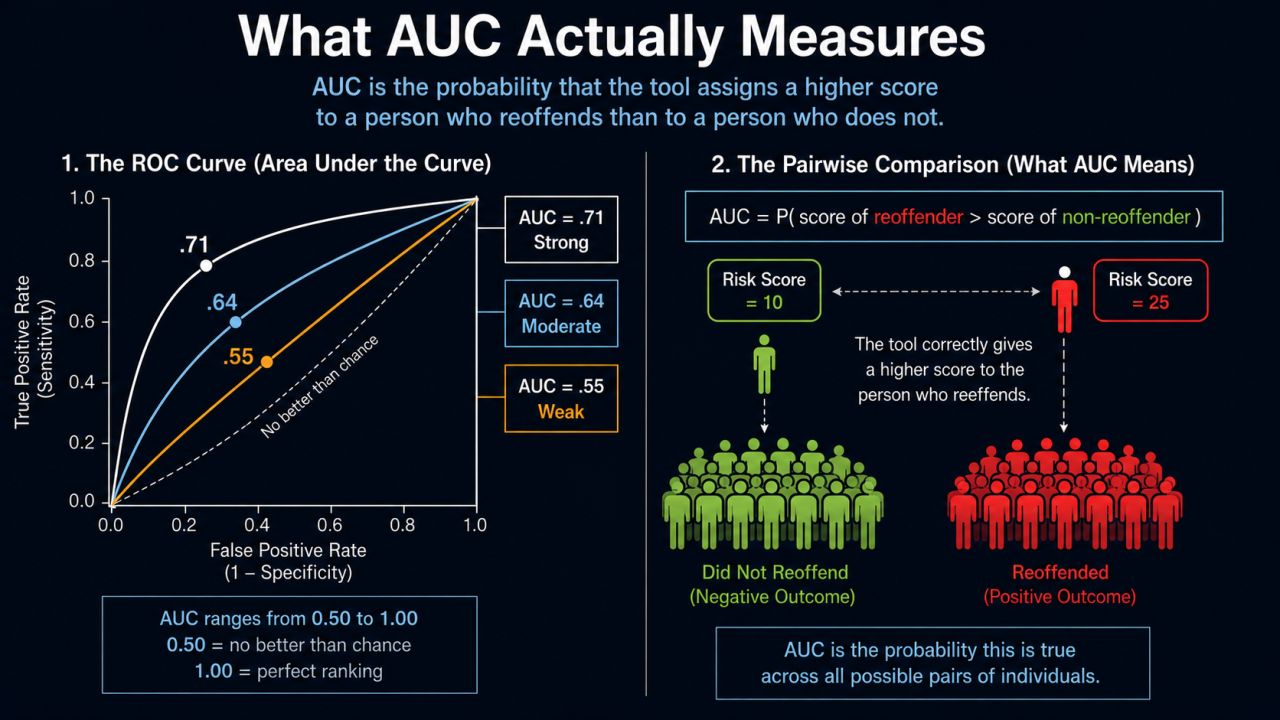
Higher AUC values mean the tool more often ranks people in the expected order.
How to Read AUC Values
- AUC = 0.50 → no better than chance
- AUC = 0.75 → correctly ranks pairs 75% of the time
- AUC = 1.00 → perfect separation
What AUC Is Not About
AUC is not about exact probabilities. It is also not about individual predictions.
It tells you how well the tool ranks people from lower to higher risk, not whether a specific score corresponds to a useful or well-separated probability in practice.
Bottom Line
AUC measures ranking. It tells you how often a tool orders people correctly, but it does not fully explain how risk scores behave in real decision settings.

Zachary Hamilton
Professor
My research centers on innovation in risk and needs assessment development.