Why Risk Scores Are Misunderstood
Risk scores shape real decisions.
In corrections, classification, and pretrial settings, risk scores influence decisions about incarceration, supervision, and programming. But one basic issue is often overlooked: not all risk scores mean the same thing.
A risk score is only useful if it meaningfully distinguishes between outcomes.
Where Risk Scores Show Up
Risk-needs assessment tools are used every day in:
- adult and juvenile corrections
- prison classification
- pretrial release decisions
They shape decisions about incarceration, supervision, and programming.
The Basic Problem
Two tools can assign the same “risk score," but behave very differently.
That matters because a risk score is only useful if it meaningfully distinguishes between outcomes.
Same Score, Different Performance
Both tools below assign a risk score. But they do not perform the same way.
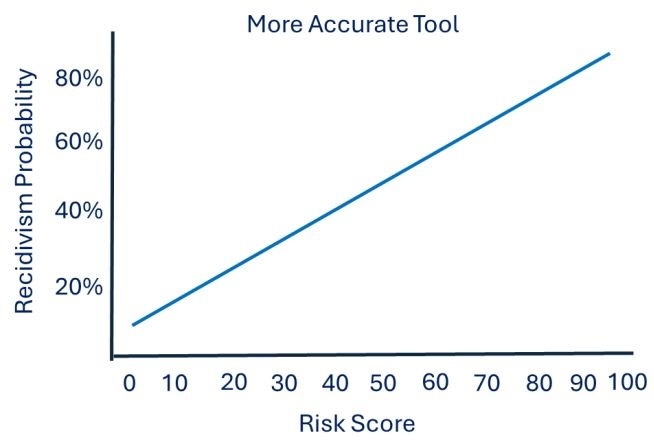
More Accurate Tool
Clear separation between lower- and higher-risk individuals.
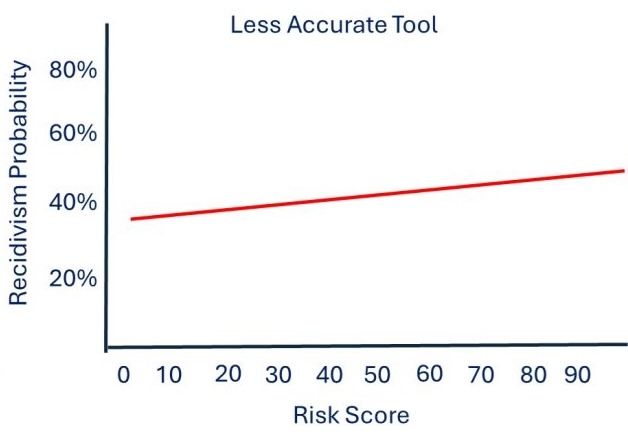
Less Accurate Tool
Scores vary, but outcomes are not well distinguished.
Why the Difference Matters
Both tools generate “risk scores.” But only one meaningfully separates outcomes.
That difference—how clearly a tool distinguishes between outcomes—is what we mean by accuracy in practice.
Why This Is Easy to Miss
Many risk assessment tools still in use today are built on empirical foundations that predate the 1980s.
However, understanding of how these tools work—and how to evaluate them—has not kept pace.
As a result, risk scores are often interpreted as if they carry the same meaning, even when they do not.
Bottom Line
Risk scores are widely used but often poorly understood. Understanding what they represent is a prerequisite for using them well.

Zachary Hamilton
Professor
My research centers on innovation in risk and needs assessment development.